Edge AI, in plain language
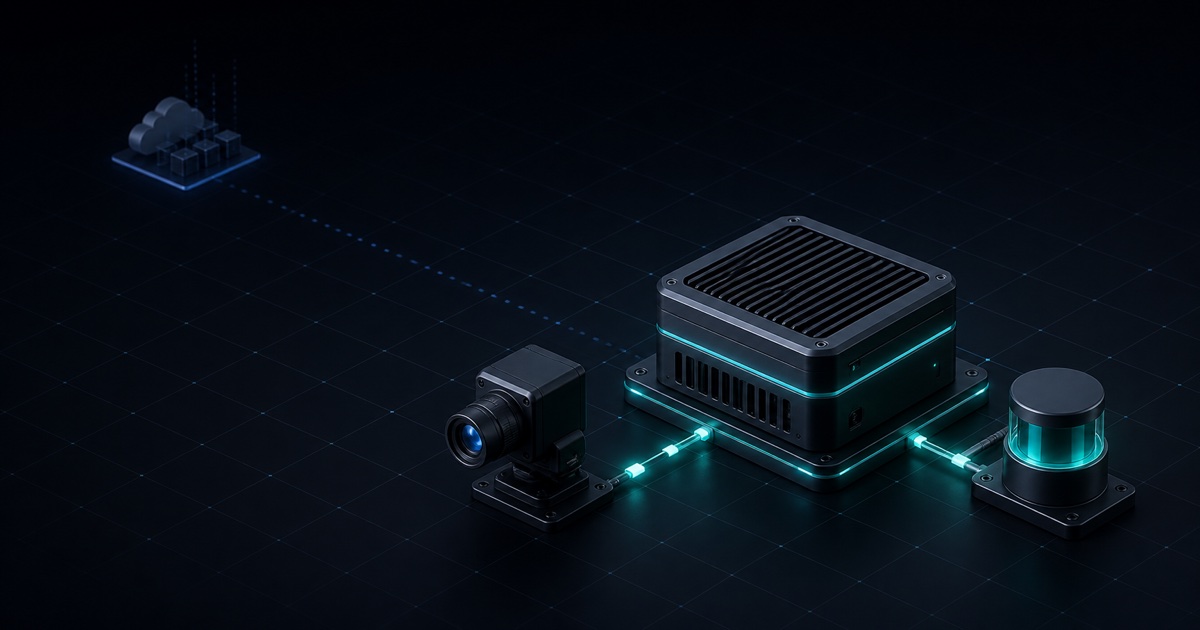
A conventional cloud AI request travels from a device or application to a centralized data center, waits for a model response, and travels back. Edge AI shortens that path by placing a model runtime in a nearby location: a customer site, retail store, factory, hospital, telecom edge, or regional facility.
That shorter path can improve response time and reduce the amount of sensitive or high-volume data that must leave the local environment. The central cloud can still handle training, fleet management, aggregated analytics, and workloads that do not need an immediate response.
The useful question is not “edge or cloud?” It is “which parts of this AI experience need to happen locally?”
What actually runs at the edge?
The edge runtime depends on the product. It may host a computer-vision model, a speech pipeline, a compact language model, an agent with local tools, or a control loop for a machine. Supporting services often include model serving, request routing, policy enforcement, telemetry, and health checks.
- Vision inference for cameras, inspection, safety, or physical-space analytics
- Voice processing for responsive assistants and local-language experiences
- Agents that need access to site-specific tools, knowledge, and permissions
- Robotics and machine control where network delay can disrupt the experience
- Privacy-sensitive processing that should remain inside an approved boundary
Why teams choose local inference
Latency is the most visible reason. When a product must respond while someone is speaking, moving, or operating equipment, a long or inconsistent network path becomes part of the user experience. Local inference removes avoidable distance.
Privacy and availability matter just as much. Processing locally can keep raw inputs inside a customer-controlled environment. A nearby runtime can also continue serving during cloud connectivity problems, provided the application is designed for graceful local operation.
- Lower and more predictable response latency
- Fewer raw data transfers across network or jurisdictional boundaries
- Continued service during intermittent upstream connectivity
- Site-specific models, vocabulary, integrations, and operating policies
Where edge AI becomes difficult
A successful prototype on one device does not automatically become a reliable multi-site product. Hardware differs. Networks fail in different ways. Models and dependencies need updates. Each customer has its own security, integration, and data requirements.
This is why edge AI is an infrastructure problem as much as a model problem. Teams need repeatable placement, observability, versioning, health management, and rollback across many locations without turning every deployment into a custom project.
When edge AI is the right fit
Start with the experience rather than the infrastructure. Map the acceptable response time, the data boundary, what must work during a connectivity interruption, and which parts of the behavior vary by location. If those requirements are strict, local inference is likely worth evaluating.
For workloads that are asynchronous, globally consistent, and insensitive to network delay, centralized cloud infrastructure may remain the simplest option. Most mature systems use both: local execution for time-sensitive or private work, and cloud services for coordination and global intelligence.