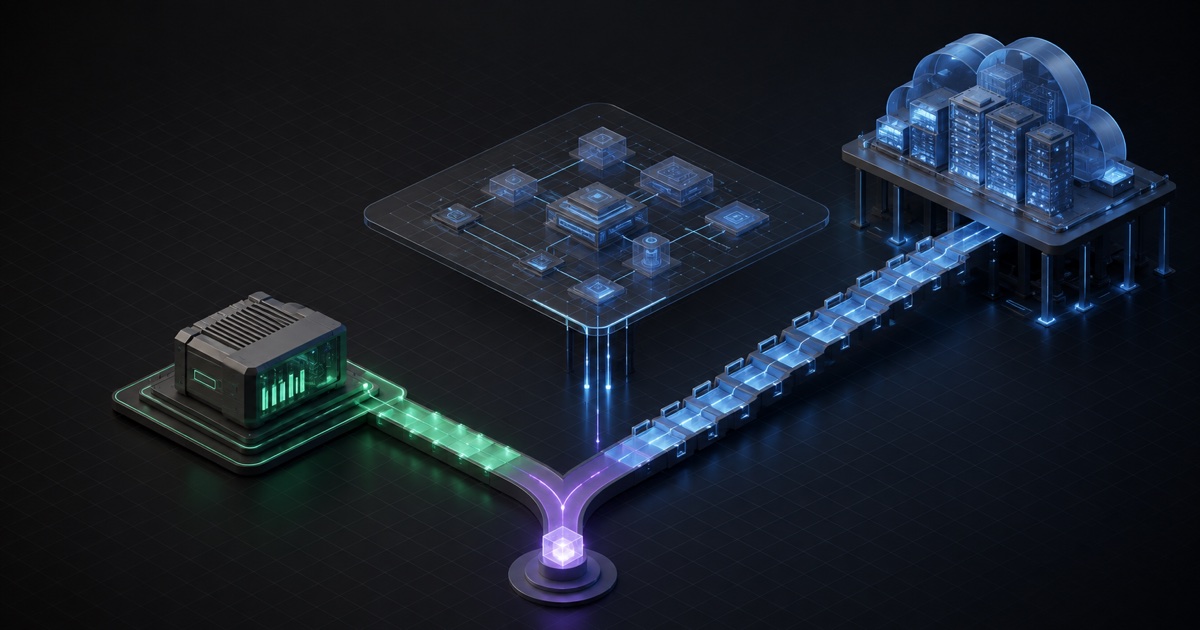
The core architectural difference
Cloud AI centralizes compute in large data centers. Applications send requests over the network and benefit from elastic capacity, mature managed services, and a consistent operating environment. Edge AI distributes inference across smaller locations closer to where requests originate.
That placement changes the system's tradeoffs. The cloud simplifies central operations. The edge shortens the data path and gives the application a local execution option. A practical design assigns responsibilities to both layers rather than forcing the entire system into one location.
Compare the six decisions that matter
Architecture should follow product requirements. Evaluate the workload across these dimensions before selecting hardware, regions, or vendors.
- Latency: Does delay or network variability change the customer experience?
- Privacy: Can raw inputs leave the site, organization, or jurisdiction?
- Availability: What must keep working when upstream connectivity degrades?
- Data volume: Is continuously moving raw video, audio, or sensor data practical?
- Personalization: Does each site need its own language, tools, policies, or model?
- Operations: Can the team observe, update, and recover a distributed fleet safely?
Placement is a product decision first. Infrastructure becomes easier to choose once the experience and data boundaries are explicit.
Where cloud AI is strongest
Centralized cloud infrastructure is well suited to model training, large batch jobs, global analytics, asynchronous generation, and services that need rapid access to elastic accelerators. It also gives small teams a fast path to launch when local requirements are not yet strict.
The cloud remains useful in an edge architecture. It can distribute models and policies, aggregate non-sensitive telemetry, coordinate deployments, and provide overflow capacity for requests that tolerate a longer path.
Where edge AI is strongest
Local execution is valuable when the application interacts with the physical world or processes data a customer considers sensitive. Voice, video, robotics, industrial systems, and on-site agents often benefit because response time, connectivity, and local context directly affect usefulness.
Edge placement can also make personalization operationally cleaner. Instead of embedding every local difference in application code, a deployment can apply a site profile that selects the appropriate model, vocabulary, integrations, and policies.
The hybrid pattern
A hybrid AI architecture separates the local data plane from the global control plane. The local layer serves requests and enforces site policy. The global layer manages desired state, versions, placement rules, and fleet-wide visibility.
Design the boundary intentionally. Decide what information may leave the site, what happens when the control plane is unreachable, how a workload proves it is healthy, and how the system returns to a known version after a failed update. Those details determine whether hybrid architecture is resilient or merely distributed.